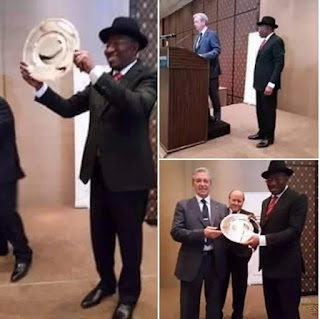
- Former Nigeria President, Goodluck Jonathan speaks on how he tackled Boko Haram as the president of Nigeria.
– The former president highlights major achievements of his tenure.
– He reveals some secrets on stabilizing Africa’s dwindling economies.
The former president of Nigeria, Goodluck Jonathan, has revealed
secrets of how he tackled Boko Haram insurgency in the northeast of
Nigeria, while he was still at the helms of affairs.
Jonathan said that one of his greatest tools for fighting the war
against against the sect, was education. He made the disclosure while
addressing a press conference at the Geneva Press Club on Wednesday,
January 27.
The former commander-in chief gave details of his post presidential
focus and touched on some of the roles his administration played in key
areas of the Nigerian and West Africa polity.
The speech which laid particular emphasis on security and education can be read below:
Though this event is billed as a press conference on a Better
Security and Education for West Africa, for the sake of time, I will
focus on my experience in government which gave me a practical
demonstration of how education impacts on security.
I will thereafter touch on my post presidential focus which is on
advancing democracy and good governance in Africa and increasing access
to opportunity for wealth generation in Africa.
If you peruse the official UNESCO literacy rates by country, what you
will find is that all of the top ten most literate nations in the world
are at peace, while almost all of the top 10 least literate nations in
the world are in a state of either outright war or general insecurity.
Lower education levels are linked to poverty and poverty is one of the
chief causative factors of crime whether it is terrorism or militancy or
felonies.With this at the back of my mind, I began the practice of
giving education the highest sectoral allocation beginning with my very
first budget as president in 2011.
My policy was to fight insecurity in the immediate term using counter
insurgency strategies and the military and for the long term I fought
it using education as a tool.
As I have always believed, if we do not spend billions educating our
youths today, we will spend it fighting insecurity tomorrow. And you do
not have to spend on education just because of insecurity. It is also
the prudent thing to do.
Nigeria, or any African nation for that matter, can never become
wealthy by selling more minerals or raw materials such as oil. Our
wealth as a nation is between the ears of our people.
It is no coincidence that the northeast epicenter of terrorism in
Nigeria is also the region with the highest rate of illiteracy and the
least developed part of Nigeria.
In Nigeria, the federal government actually does not have a
responsibility for primary and secondary education, but I could not in
good conscience stomach a situation where 52.4% of males in the
northeastern region of Nigeria have no formal Western education.
The figure is even worse when you take into account the states most affected by the insurgency.
83.3% of male population in Yobe state have no formal Western education. In Borno state it is 63.6%.
Bearing this in mind is it a coincidence that the Boko Haram insurgency is strongest in these two states?
So even though we did not have a responsibility for primary and
secondary education going by the way the Nigerian federation works, I
felt that where I had ability, I also had responsibility even if the
constitution said it was not my responsibility.
Knowing that terrorism thrives under such conditions my immediate
goal was to increase the penetration of Western education in the region
while at the same time making sure that the people of the region did not
see it as a threat to their age old practices of itinerant Islamic
education known as Almajiri.
For the first time in Nigeria’s history, the federal government which
I led, set out to build 400 Almajiri schools with specialized curricula
that combined Western and Islamic education. 160 of them had been
completed before I left office.
I am also glad to state that when I emerged as President of Nigeria
on May 6th 2010, there were nine states in the northern part of the
country that did not have universities. By the time I left office on the
29th of May 2015, there was no Nigerian state without at least one
federal university.
Now the dearth of access to formal education over years created the
ideal breeding ground for terror to thrive in parts of Nigeria but there
are obviously other dimensions to the issue of insecurity in Nigeria
and particularly terrorism.
You may recall that the fall of the Gaddafi regime in August 2011 led
to a situation where sophisticated weapons fell into the hands of a
number of non state actors with attendant increase in terrorism and
instability in North and West Africa.
The administration I headed initiated partnership across West Africa
to contain such instability in nations such as Mali, which I personally
visited in furtherance of peace.
And with those countries contiguous to Nigeria, especially nations
around the Lake Chad basin, we formed a coalition for the purpose of
having a common front against terrorists through the
revived Multinational Joint Task Force (MNJTF).
Those efforts continue till today and have in large part helped decimate the capacity of Boko Haram.
Another aspect of the anti terror war we waged in Nigeria that has
not received enough attention is our effort to improve on our
intelligence gathering capacity.
Prior to my administration, Nigeria’s intelligence architecture was
designed largely around regime protection, but through much sustained
effort we were able to build capacity such that our intelligence
agencies were able to trace and apprehend the masterminds behind such
notorious terror incidences as the Christmas day bombing of the St.
Theresa Catholic Church in Madalla, Niger state.
Other suspects were also traced and arrested including those behind the Nyanya and Kuje bombings.
Not only did we apprehend suspects, but we tried and convicted some
of them including the ring leader of the Madalla bombing cell, Kabir
Sokoto, who is right now serving a prison sentence.
But leadership is about the future. I am sure you have not come here
to hear me talk about the way backward. You, like everyone else, want to
hear about the way forward.
I am no longer in office, and I no longer have executive powers on a
national level. However, I am more convinced now than ever about the
nexus between education and security.
My foundation, The Goodluck Jonathan Foundation, was formed to
further democracy, good governance and wealth generation in Africa.
Of course, charity begins at home and for the future, what Nigeria needs is to focus on making education a priority.
Thankfully, the administration that succeeded mine in its first
budget, appears to have seen wisdom in continuing the practice of giving
education the highest sectoral allocation. This is commendable.
I feel that what people in my position, statesmen and former leaders,
ought to be doing is to help build consensus all over Africa, to ensure
that certain issues should not be politicized.
Education is one of those issues. If former African leaders can form
themselves into an advisory group to gently impress on incumbent leaders
the necessity of meeting the United Nations Educational, Scientific and
Cultural Organization (UNESCO) recommended allocation of 26% of a
nations annual budget on education, I am certain that Africa will make
geometric progress in meeting her millennium development goals and
improving on every index of the human development index.
Data has shown that as spending on education increases, health and
well being increases and incidences of maternal and infant mortality
reduce.
In Nigeria for instance, average life expectancy had plateaued in the
mid 40s for decades, but after 2011, when we began giving education the
highest sectoral allocation, according to the United Nations, Nigeria
enjoyed her highest increase in average life expectancy since records
were kept. We moved from an average life expectancy of 47 years before
2011 to 54 years by 2015.
I had earlier told you about the connection between education and insecurity.
I believe that it is the job of former leaders and elder statesmen to
convince executive and legislative branches across Africa to work
together to achieve the UNESCO recommended percentage as a barest
minimum.
I intend to offer my services, through The Goodluck Jonathan
Foundation, for this purpose and I invite interested organizations to
help us make this happen.
Ladies and gentlemen of the press, this, in a nutshell are some of my
thoughts for a better security and education for Africa and I will now
entertain your questions,” the statement reads.
The Vanguard reports that the conference was well attended, with an
audience made up mostly of diplomats, policy makers and journalists.
In the same vein, GEJ has made some remarks regarding the ongoing $2.1
billion arms scandal thatis rocking Nigeria at present. The ex-president
said he would not interfere with ongoing prosecutions, adding that his voice will be heard on the issue in due course.